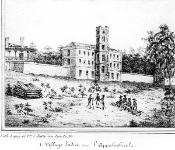
Above is a picture of the Arsenal at Chattahoochee, FL shortly after construction in 1839. This was one of the installations taken over by the Florida Militia when the state seceded in 1861. Image courtesy of the Florida State Archives.
THE OUTBREAK OF WAR
Even as the secession convention sat the civil and militaryleaders of the various sections of the state were preparing for action. Governor Perry had ordered the seizure of the federal arsenal at Chattahoochee, Fort Marion at Saint Augustine, and Fort Clinch at Fernandina and state control of all three had been accomplished by January eighth. The seizure of these posts was relatively simple since none of the three was garrisoned with more than a handful of soldiers. At Pensacola and Key West, however. the federal forces had begun preparations for defense against seizure before the convention assembled. When news of the secession ordinance reachd Key West, the half-hundred troops on the island were moved inside Fort Taylor. Although turbulence and aggressive feelings existed among the southern sympathizers, no determined act against the forces at Key West was ever made. At Pensacola the presence of the navy yard and three forts on the best protected and deepest harbor of the Gulf Coast made the control of the base and fortifications on the Bay a group of prizes of high value. Without superior orders the officer in command at Fort Barrancas abandoned the mainland fortifications and transferred his command of a hundred men to Fort Pickens on Santa Rosa Island where the federal forces could guard the entrance to Pensacola Bay.
On the tiny islands of the Dry Tortugas, almost seventy miles west of Key West, the War Department had conceived an American Gibraltar. With plans for a mighty six-sided fort, three tiers high, a super-fortification of 250 guns to be manned with a war complement of 1,500 men, Fort Jefferson on Garden Key had been under construction for fifteen years when Florida seceded. On the eve of the war a million and a quarter dollars had been spent on Fort Jefferson. When the secession ordinance was signed at Tallahassee there were but thirty men on the island all of whom would remain loyal to the United States, but on January 19, 1861 a transport brought artillerymen and guns from Boston harbor to strengthen the fort's defense. Though repeatedly challenged Confederate privateers, Fort Jefferson remained in federal hands and helped cut the Confederate lifeline between the Atlantic seaboard and the Mississippi and Gulf ports. Later Fort Jefferson became a Devil's Island and in the post-war years, the home of a number of celebrated prisoners, most notably Dr. Samuel Mudd ;whose only crime had been to render medical aid to John Wilkes Booth whom Mudd didn't know had assassinated President Lincoln.
Through the winter of 1860-61, both before and after the state had seceded, military companies were organized in all of the towns and counties. After secession the troops were mustered into the Army of Florida (state militia) and held ready for future call. Companies of "Minute Men" were formed throughout the state and were "accepted by Perry as part of the State Militia even though they operated more on the principle of a home guard. All companies at this time were created and equipped by private funds which the governor promised to repay from state funds upon their acceptance into the militia. Governor Perry issued many commissions to his friends throughout the state; and upon his recommendation, the state legislature passed a bill on February 14th which allowed lieutenants and captains holding commissions to enlist volunteers in their districts."
Both the governments of the seceded states and the Confederacy held the belief that the conflict of North and South would be of short duration. Through 1861 volunteers were enlisted for a term of twelve months. When the Confederate States Army was created in March 1861 the president was empowered to call on the militia of the states to repel invasion and to enlist a hundred thousand volunteers as national troops for a term of one year. On March 7, General Braxton Bragg ,was given command of the "Provisional Army of the Confederate States," on Pensacola Bay. The national troops were raised by requisition on the several state governors who were encouraged to organize military units in their own bailiwicks to be transferred into the Confederate army.
The first requisitions for Confederate troops were made on March 9, 1861 for 5,000 men for duty at Pensacola. Florida's first quota, under this requisition, was for 500 men. The First Florida Infantry was mustered into the Confederate army on April 5. Requisitions for 5,000 Florida troops were received by Perry before July first.
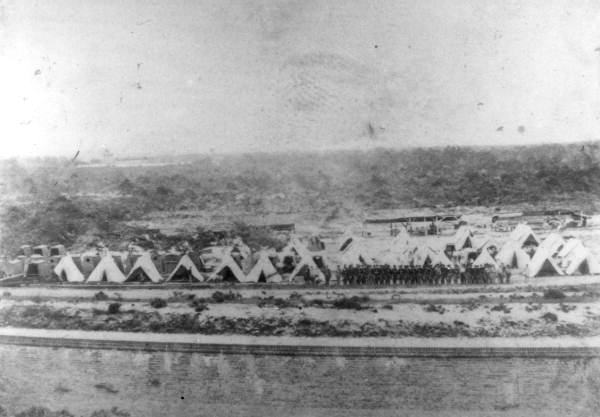
Above is a picture of the Confederate Encampments at Pensacola, Florida in 1861. Image courtesy of the Florida State Archives.
By the middle of April Bragg was in command of 5,000 troops from the several states at Pensacola. Florida and Confederate forces had occupied the evacuated forts of Barrancas and McRee, and on January twelfth had demanded and received the surrender of the Pensacola navy yard. The federal troops at Fort Pickens, however, refused to surrender and the Florida and Confederate forces hesitated to attack the fortification for fear of bloodshed and subsequent charges of opening the hostilities. Telegrams from Yulee and Mallory advised a movement on Fort Pickens at the time of Florida's secession, but later they reversed their stand and advised in late January that nothing radical should be done, in order to forestall incidents leading to war before the southern confederacy was formed. Until Buchanan left office as president of the United States on March third a "Fort Pickens Truce" was observed under which neither side agreed to reinforce or attack the fort on Santa Rosa Island. When Lincoln became president he decided to disregard, under cover, the Buchanan promises and on April 12 reinforcements were moved into Fort Pickens by small boats from ships standing outside in the Gulf of Mexico. Four days later a thousand men were in Fort Pickens while the crews of four United States warships standing off the bar raised the total federal forces to two thousand, and the chance of the Confederates to seize Pickens had passed.
The first offense of the war in Florida occurred on the night of September 2 when a raiding party from Fort Pickens boarded the navy yard dry dock and burned a repair vessel. Less than two weeks later three launches loaded with sailors from the U. S. S. Colorado reached the Confederate schooner Judah, moored at the navy yard docks, and after fierce fighting burned the ship. Three of the raiders were killed and twelve wounded the first war casualties in Florida.
On October 9 Bragg ordered a thousand man raid on the federal encampment in the rear of Fort Pickens on Santa Rosa Island. The Confederates surprised the Yankees, but the ensuing fight ended in something of a drawn battle with both sides suffering relatively high casualties from the skirmish. On November 22 artillery duels between the federal forces in Fort Pickens and ships in the bay with the Rebel forces in Forts Barrancas and McRee were begun and continued off and on until the twenty-fourth. Neither side could claim victory, although the damage to the Confederate batteries was heavier. The duels demonstrated, however, the strength of Fort Pickens and the power of the federal forces to control the best naval base and harbor on the Gulf coast, a position the United States forces maintained throughout the war.
In the fall of 1861 the Confederate government stopped the policy of requisitioning the several governors and created military district~ in the seceded states under the command of military officers. Requisitions from the central government were passed to the district commands who sought aid from the governor in meeting the quota.
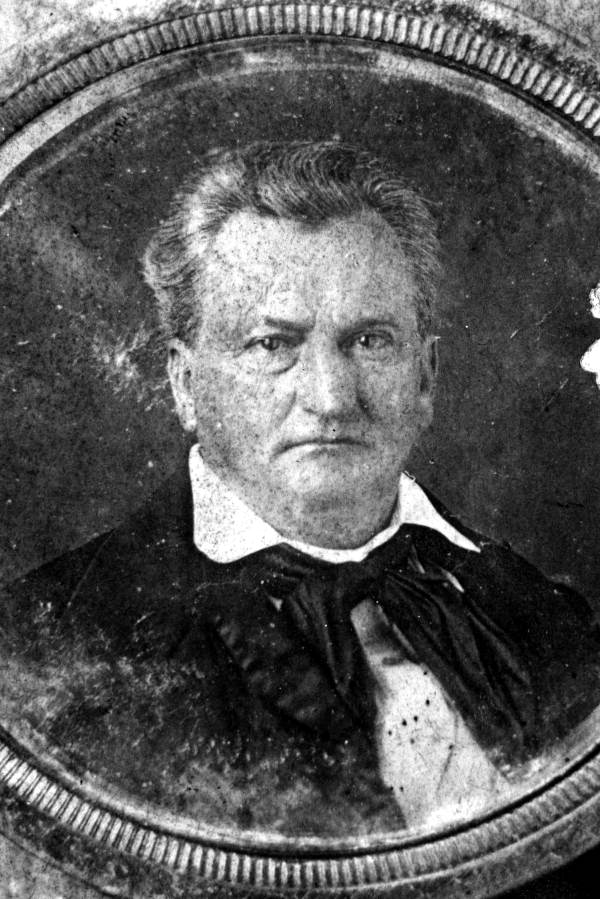
Above is a picture of Governor John Milton who served as Florida's Governor from 1861 until he committed suicide as the Confederacy was defeated in April of 1865. Image courtesy of the Florida State Archives.
When John Milton became governor in October 1861 he began a program of reorganization of the state militia. Perry had used the powers of military appointment to reward friends and had broken up regiments into companies in order to promote more officers of field grade. Milton reassembled "the state forces of 14 companies, placing 4 companies at Fernandina and 9 companies at Apalachicola." At the same time troops raised for transfer to the Confederate armies were equipped before being shipped to poorly supplied Confederate forces.
Governor Milton was concerned with the establishment of proper defenses on the Gulf coast at Apalachicola and St. Marks. General Bragg, in command in West Florida, had organized that area for defense with the forts in the Pensacolaarea. In East and Middle Florida Milton hoped to repel federal invasion through the use of fixed fortifications to be strengthened from the rear with infantry and artillery forces. Milton considered the use of cavalry as a coast defense to be useless and expensive, and he emphasized the need for batteries with heavy guns at important points and gunboats with lighter fire power to guard between such points.
In the early months of the war the Confederate government planned to defend the approaches to Apalachicola; the harbor and railroad terminus at Fernandina; the port of Jacksonville; and Pensacola and the navy yard at Pensacola. Munitions and troops were dispatched to these points; Cedar Key and all other towns on the coast were left undefended. Even at the towns to be defended the military supplies were woefully short. But by February 1862 the pressure of the federal forces in Tennessee and Kentucky brought a sweeping order to the Florida departments to withdraw all men and supplies northward to defend the northwest border of the Confederacy. By the middle of April only 1500 Confederate troops remained in the Pensacola area, and a month later there were but 1000 left in the eastern and middle sections of the state. Coast defenses were generally dismantled and military ordnance had been moved into the interior. Governor Milton reflected the temper of the people of Florida when he wrote the Confederacy had abandoned most of "Florida to the mercy and abuse of the Lincoln Government." The seriousness of the Confederate situation, however, was revealed when the Conscription Act of April 16, 1862 was passed to hold the southern armies together.
The evacuation of the troops from the coast defenses of Florida fitted in well with the plan of the federal navy department to extend control southward along the Atlantic seaboard and around the Gulf coast. By November 1861 the federals held Port Royal, South Carolina and the next logical step would be the investment of Fernandina in the movement toward Key West and the strengthening of the union blockade. During the war Key West served as a nerve center for the intelligence services of both armies. Whites and blacks with union leanings entered the town which remained in federal hands. Confederate sympathizers on the island served as liaison contacts for the forwarding of information to their beleaguered comrades. When information reached Key West that Cedar Key, the Gulf terminus of the Florida Railroad, lacked the defense of either materiel or manpower the U. S. S. Hatteras landed sailors and marines there on January 15, 1862. The federals found the town deserted and proceeded to burn eight loaded schooners and sloops, the railroad depot, freight cars, and a warehouse filled with naval stores. In addition, all telegraph lines were brought to the ground.
At the end of February a Federal invasion force of eighteen gunboats and armed transports, six steamers, and eight sailing craft left Port Royal for the invasion and investment of East Florida. On March 3 the task force approached Amelia Island as the last train was crossing the trestle to the mainland. According to one account the town of Fernandina was virtually abandoned by troops and residents and Senator Yulee, on the last train, witnessed gunboat fire which pierced his car and "the man by his side was fatally wounded."
Col. Edward Hopkins,Amelia Island commander, was reported to have become ill at the Fernandina defenses and few guns or other munitions were withdrawn as a result. The residents left the town in disorder and the remaining troops fled in retreat. The federal forces occupied the town and Amelia Island was returned to the jurisdiction of the United States.
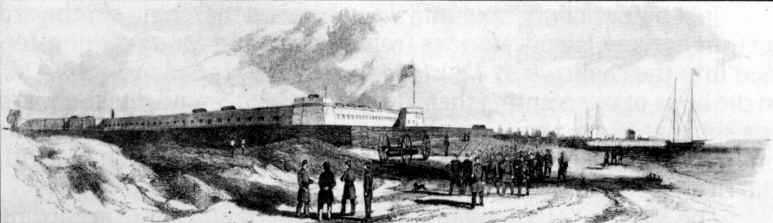
Above is a picture of Fort Clinch and Amelia Island shortly after it was captured by US Forces in 1862. Image courtesy of the Library of Congress.
On March 8 a task unit of gunboats, launches, and a transport sailed from Fernandina for Jacksonville and St. Augustine. On the night of the eleventh several hundred irregular Confederate troops, warned of the federal advance, arrived in Jacksonvillewith orders to burn and destroy such property as might be of value to the enemy. These irregulars set the torch to sawmills, warehouses, machine shops, railroad buildings, business houses, and even private dwellings. When the invaders arrived the following day most of the town of Jacksonville was a shambles as the "regulators" had plundered the establishments that were not destroyed by fire. A meeting of "loyal" citizens was held anda premature political reconstruction was undertaken in the creation of a local government which fell as soon as the federals withdrew in April.
The federal occupation of St. Augustine took place on March 11,1862. Federal officials were escorted from the wharf to thetown hall where the mayor and council formally surrendered thetown. "The people of St. Augustine seemed less perturbed thanthose of Fernandina and Jacksonville. About one-fifth of the2,000 inhabitants had left the town on the approach of theFederal warship. The small Confederate garrison had retiredinto the interior the night before." The naval commander who accepted the surrender wrote: "I believe many citizens are earnestly attached to the Union, a large number silently opposed to it, and a still larger number who care very little about thematter. I think that nearly all the men acquiesce in the conditionof affairs."
By April 1862 the federal forces controlled the east coast from the St. Marys to St. Augustine, but the Confederate forces hadonly fallen back to Baldwin and twenty or thirty miles from thecoast. Irregular troops and "bushwhackers" moved at will in the interior of the state and most of the native population had gone inland to avoid the Yankee invasion.
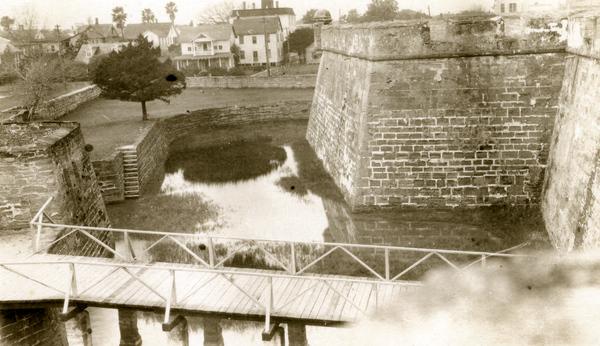
Above is a picture taken from the walls of Ft. Marion showing Ft. Marion and the town of St. Augustine circa 1863. Image courtesy of the Florida State Archives.
At this time the Gulf coast from Pensacola remained in Confederate hands, though Cedar Key had suffered a momentary invasion. As on the east coast the continued withdrawal of troops for service on the northern front exposed the Gulf coast to the sporadic raids of the ships of the federal blockading squadrons. On April 2 Apalachicola was occupied by a small force of marines and sailors. "The town presented a desolate appearance. The batteries were dismantled; the warehouses and shops were closed; the streets and wharves were deserted; the harbor was empty of ships. Perhaps 500 people out of a population of 2,500 remained. Those left behind were mostly poor whites and free negroes. Destitution was apparent-no flour,no sugar, no meat, and very little com. The people were dependent on fish and oysters for subsistence."
At Pensacola, in the spring of 1862, the future offered few prospects other than gloom and despair. Timber and sawing operations had long ceased; many residents had departed for the interior, and merchants had closed their stores and shops. Local "bushwhackers" roamed as predators and bullied or stole for a living. When the decision to abandon Pensacola was reached the order went out to destroy everything which might be of service to the enemy.
The work of destruction in extreme West Florida began on March 11 and continued through May 10. Saw mills, lumberstores, warehouses, naval stores, boats and gunboats, forage,food supplies, and clothing not absolutely essential to the civilianpopulation were all burned or sabotaged. Munitions and machinery from the naval' yard that could be removed was sent north toAlabama. Even the railroad leading out of Pensacola was ordered torn up and the bridges burned. "At midnight on the 9th of May, the final preparations were completed. and Pensacola was evacuated. All day people had been leaving the city by all available means. Crowded trains had borne away the families whose homes must be abandoned. Frightened children, bewildered by their strange surroundings, clung weeping to mothers or nurses almost as bewildered themselves. Notice had been short, and little was clear except that by the inexorable decree of war all that stood for security and comfort was left behind. At the last moment, the navy yard, the steamers, and the public buildings were set on fire, and the beautiful bay was aglow with the flames. The federal guns at Fort Pickens had in vain tried by a fierce cannonading to prevent the Confederates from carrying out their plan. All was done; the last troops moved out; and the last strong position on the Florida coast was lost. On May 10 the town was abandoned to the federal forces. Thus, Key West, Fernandina, St. Augustine, and Pensacola were returned to the "Stars and Stripes" of the United States after but little more than one year under the "Stars and Bars" of the Confederate States.
The fate of Jacksonville, however, was to play the rope in the tug of war between the Yankees and the Rebels. The town, occupied in March 1862 to establish federal domination and perhaps to give aid to the Union sympathizers, was evacuated in less than a month. No adequate explanation for the departure was ever given, but the federal evacuation crippled the"loyalists" of whom "some fifty or sixty went to New York City and the public press took up their case so piteously that the city council voted $1,000 for their immediate relief."
The federal blockade of the St. Johns River was maintained by gunboats of the South Atlantic squadron with their station at Mayport Mills, a steam sawmill, a settlement that has continued in the present town of Mayport. The federal gunboats patrolled the river to Jacksonville and beyond at will. To prevent the federal patrols from reconnoitering up the St. Johns General Joseph Finegan, commander of the Confederate forces in East Florida fortified St. Johns Bluff. Four miles above Mayport, as the river runs, the bluff was ideal "for the purpose-a steep promontory rising from the river's edge to an elevation of more than 70 feet, the channel of the river running close inshore at that point."
By September 9, 1862 General Finegan's forces had fortified the bluff and about the same time a slave who had sought the federal lines informed the gunboats at Mayport Mills of the rebel maneuver. From September 10 through 30 the federal gunboats sought to dislodge the cannoneers on the bluff without success. The successful effrontery of the Confederates in blocking the passage of the St. Johns for three weeks forced the federal forces to dispatch four transports and 1600 men to the area for a joint sea and land attack. Under convoy of six gunboats the task force moved into the river on October first.
The Confederate scouts magnified the federal strength into a force of three thousand men and as the rebel forces approached six hundred only, an orderly retreat was ordered on October second. The federal forces razed the abandoned fortification of the bluff the following day and on October 5, 1862 continued to Jacksonville. Shortly after landing, a detachment of "rebel cavalry" attacked the Yankee pickets. "The outpost fired and fell back on the reserve. How the Seceshes did yell," wrote Captain Valentine Chamberlain of the 7th Connecticut Volunteers. "I looked for them to come through the small timber. I heard one of my sergeants calling me, I looked behind and saw the captain in command of the 47th falling. I at first supposed him shot, but he had only fainted. He was quite frightened and had never been in any muss before." The rebels were repulsed, but not before the "rebel yell" had felled one yankee captain!
Of the second Jacksonville occupation, Chamberlain wrote that the morning of the sixth "was a gala time with the boys before the General found out what was going on, almost every store and shop on the street was broken into. Most of them had been closed for a long time, but there were goods in a few. A drug store was the best place. The boys pulled everything open and such a medley as they brought away. You can imagine, perhaps, a drug store, with most of the articles packed, opened and overhauled by soldiers and then . . . back to their bivouac with their plunder .... The general soon put a stop to most of this indiscriminate plundering."
A company of soldiers and two gunboats made a sortie up the river in search of rebel steamers and to "get the bounties of some union men." The expedition captured the eighty-five footsteamer Governor Milton in a creek above Lake George and returned with this booty as well as some "unionists," after ruthless raiding and burning along the banks of the upper St. Johns. In a few days the Yankees left Jacksonville with some white and black refugees, for with a garrison at the St. Johns Bluff the river and the town could be occupied at any time.
In March 1863 federal troops returned to Jacksonville a third time. William Watson Davis, student of the period, wrote: "They came to collect negro recruits, to plunder, and probably to inaugurate some vague plans of 'loyal' political reconstruction."The Yankee forces were comprised of two regiments of Negroes under Colonel Thomas W. Higginson and reinforcements from the 6th Connecticut and 8th Maine. The Yankee troops pitched their camps at the town and occupied much of their time in conducting raids into the rural areas of the vicinity in search of plunder and Negro recruits. The presence of the black troops under Colonel Higginson so infuriated the Confederate cavalry that retaliatory forays were made on the Federal forces and a number of sharp guerilla battles ensued. Private homes were invaded and there was unnecessary abuse of non-combatants. As both Negro slaves and plunder were scarce the Federal troops evacuated the Duval county section at the end of March but not before the Yankee troops from New England again scoured Jacksonville for loot and fired many buildings including several churches. By April second, at least a third of the town was in ashes as a result of the savage vandalism of the drunken and irresponsible yankees."
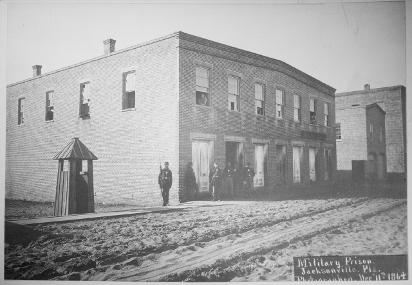
Above is a picture of some of the warehouses in Jacksonville, Florida that were turned into military prisons by the occupying Union forces in 1864. Image courtesy of Wikimedia Commons.
In the first two years of the war eight infantry regiments and two cavalry regiments were formed in Florida. Virtually all of the men in the infantry regiments went into combat in either the western or northern theaters of action. As the Confederate government could not furnish the equipment for the cavalry only a few of the cavalry companies continued on duty through the war. Several companies of artillery were enlisted for duty with the Confederacy. In the later years of the war a number of other regiments and companies were formed. Approximately 15,000 Floridians saw service in the Confederate Army with some 5,000 casualties. In addition, 1,200 Floridians, not including Negroes, joined the United States Army. Florida troops were in action on all fronts from April 1861 at Pensacola through the memorable battles at Corinth, Shiloh, Yorktown, Seven Days', Gaines' Mill, Second Manassas, Gettysburg,Vicksburg, Chickamauga and on to the surrender of the armies of Lee and Johnston in April 1865. Florida gave the South several illustrious military men. General Kirby Smith, born in St.Augustine in 1824, became one of the seven full generals of theConfederate Army and was in command of the army and territory west of the Mississippi after February 1863. General W. W. Loring has already been mentioned. General Francis A. Sharp, of St. Augustine, and General Martin L. Smith, chief engineer of the Florida Railroad, were both transplanted Yankees who fought for the South.
